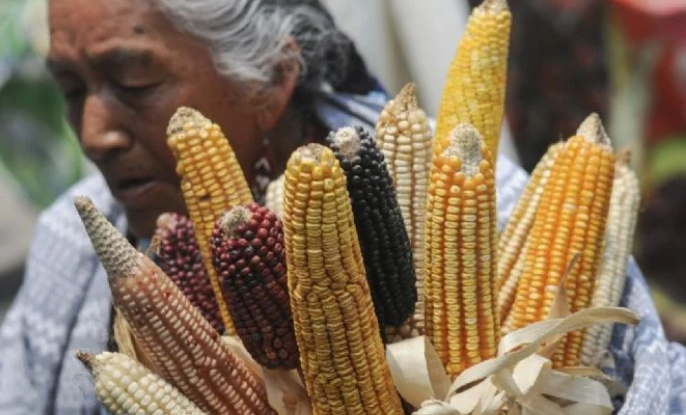

Native corn and indigenous languages are at risk due to the current national situation; experts predict that without adequate protection they could be forgotten.
The preservation of native corn varieties and indigenous languages in Nayarit has become an urgent issue for researchers and indigenous communities, who warn of the risk of the disappearance of an important part of the state’s and the country’s cultural identity.
Researcher Tutupika Carrillo de la Cruz, from the Center for Studies and Languages at the Autonomous University of Nayarit (UAN), pointed out that there are 64 varieties of native corn in Mexico, and at least 5 are registered in Nayarit, with Jala corn being the most well-known.

He explained that these corn varieties are primarily preserved by indigenous communities in the mountainous region, where they are used for self-consumption, livestock feed, and traditional rituals.
Hybrid Seeds and Their Impact on the Nayarit Ecosystem
“Corn not only nourishes the body, but also the soul and spirit,” the researcher stated, emphasizing that for many Indigenous communities, corn represents “the mother,” and therefore its preservation is deeply linked to spiritual life, ancestral knowledge, oral literature, and traditional songs.
Carrillo de la Cruz warned that the introduction of hybrid and genetically modified seeds poses a threat to native corn varieties, primarily because many communities lack the necessary resources to cope with the replacement of their traditional seeds. He indicated that there is currently a proposed law seeking to create a balance and guarantee protection mechanisms for these native varieties.
In addition to the risk to native corn, the specialist warned about the critical situation facing Indigenous languages. He noted that approximately 30 percent of the country’s Indigenous languages are facing serious decline and that more than half of the 68 languages spoken in Mexico could disappear during this century.
In Nayarit, the Meshikan and Odam languages are at high risk due to factors such as discrimination, racism, marginalization, poverty, and the lack of bilingual education in Indigenous communities. As an example, he mentioned that in Santa Cruz de Acaponeta, only six Meshikan speakers have been identified, even though the National Institute of Statistics and Geography (INEGI) previously reported nearly 100 speakers.
The researcher pointed out that most of those who still speak these languages are elderly adults, which increases the risk of the disappearance of both the language and the knowledge and traditions associated with it.
Source: heraldodemexico