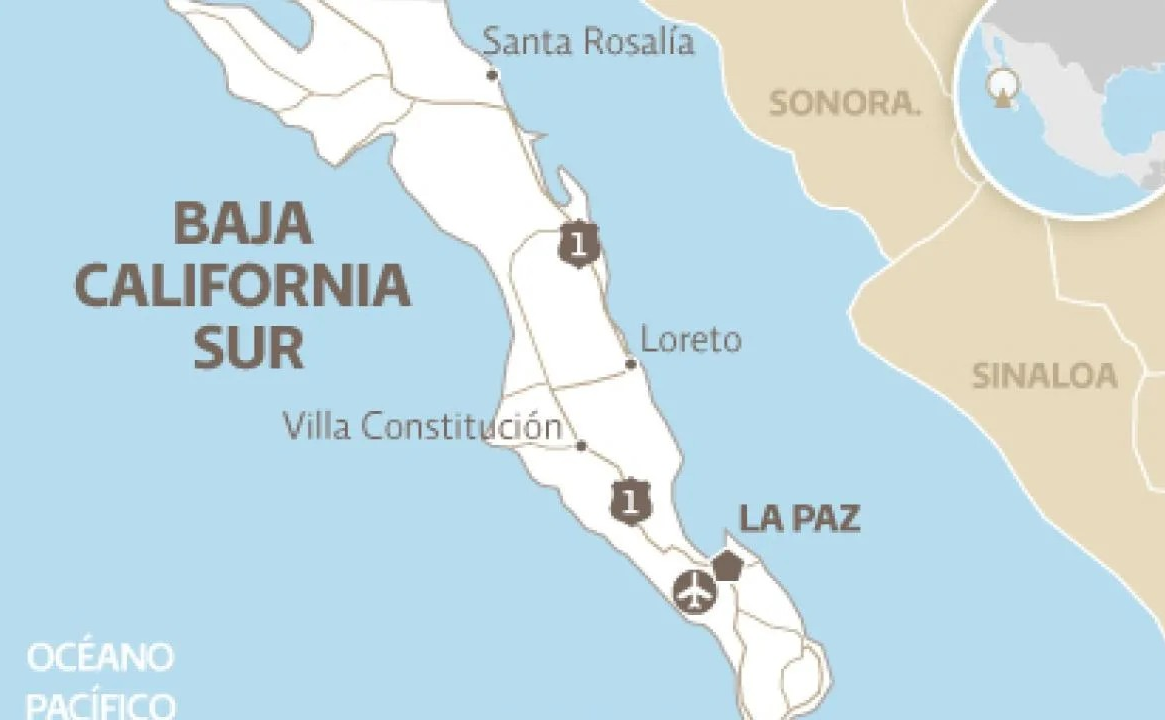

Baja California Sur, Hidalgo, and Nayarit led industrial growth in 2025 among Mexican states, in an environment where industrial activity fell 1.3% nationally, according to data from the National Institute of Statistics and Geography (INEGI).
Baja California Sur, with 9.3% growth, experienced higher growth than the other states “due to strong activity in construction, primarily in Los Cabos and La Paz,” where tourism infrastructure stands out; “electricity generation was also a significant factor last year,” explained economic analyst Kristobal Meléndez.
Hidalgo ranked second nationally with 7.1% growth “due to a considerable recovery in manufacturing, particularly the automotive industry, and its geographic location, which attracts nearshoring investment,” he added.
These states were followed by Nayarit with a 6.7% annual increase, Tamaulipas with 6.2%, and Colima with 5.5%, the latter also driven by infrastructure projects such as the expansion of the Port of Manzanillo.
In the case of Tamaulipas, “it has presented a more stable profile due to its mining and oil activities. In turn, its proximity to the United States allows it to attract constant investment.”
Tamaulipas, Nuevo León, Hidalgo, and Jalisco were the states that contributed most positively to the performance of national economic activity, which “suggests that the greatest support came from territories with a larger industrial base and better connections to the production chains in the north and west of the country,” explained economic analyst Héctor Magaña.
The current environment reflects the relocation of production, but “concentrated in already consolidated industrial corridors, especially those most connected to exports, manufacturing, and logistics.”
Border states and those with a manufacturing tradition experienced contractions in their industrial activity, such as Coahuila with a 4.3% drop, Chihuahua with a 2.1% drop, and Baja California with a 1.0% drop.
The uncertainty generated by the United States’ 2025 tariff policies created a climate of caution in some sectors and slowed orders and investment. Although “in others it opened up space for Mexican producers to gain market share against competitors from other countries,” it also accentuated the differences between states.
“The country ended the year with less industrial growth, less momentum in civil engineering projects, and a more cautious investment environment,” Magaña added.
Quintana Roo experienced a contraction of 46.5%, Campeche of 17.1%, and Tabasco of 9.8%, a trend that points to “the exhaustion of the momentum provided by large construction projects; on the other hand, the weakness of the oil and energy sector, which continues to have a decisive impact in Campeche and Tabasco.”

Source: es-us.noticias.yahoo